
In recent weeks, a clip from earlier this year has resurfaced in which Christian influencer Bryce Crawford said “If someone right now stood up and walked in the middle of the Gaza Strip and said ‘I’m a Christian,’ before they could even finish that sentence they’d be killed, and you and I are too nervous to share our faith because we’re ‘scared.’”
Crawford used this statement to build a broader point, arguing that there is no good reason to avoid proselytizing in the environment in which American Christians live, where no such thing would happen.
That said, this article isn’t about Crawford’s broader point, it’s about the claim he used to set it up: Is it true that someone would be shot dead in Gaza for proclaiming they are Christian? And if it isn’t true, does it matter that he said that?
The answers to these questions are “no” and “yes” respectively. It is not true that someone would be shot dead in the Gaza Strip for proclaiming their faith in Christ and it does matter that Bryce Crawford would tell such a lie.
The True Danger to Christians in Gaza
While it is absolutely true that Christians in the Gaza Strip face grave danger, the reality of this persecution is not at all like Bryce Crawford insinuated in his statement.
When Crawford claimed that someone proclaiming their faith in Christ in the Gaza Strip would be shot dead before they could finish the statement, he was clearly insinuating that the people of the Gaza Strip are violently hostile towards Christians.
Yet, if we are to compare Bryce Crawford’s insinuation about what it’s like to be a Christian in Gaza with the reality the Christians who live in Gaza actually face, we find a very different story.
In reality, the greatest perpetrator of violence against Christians in the Gaza Strip is the State of Israel and its armed forces. If you don’t believe me, all you have to do is look at the history of Gaza’s three churches: the Church of St. Porphyrius (Greek Orthodox), The Holy Family Church (Catholic), and the Gaza Baptist Church.
While there are no confirmed reports of Muslim attacks on any of these churches, all three of these churches have been attacked by the IDF in several incidents including both before and after October 7, 2023.
The Church of St. Porphyrius is the oldest church in the Gaza Strip, with its current building dating back to the mid-12th century. The church was attacked for the first time in its nine-hundred-year history (which included eight centuries of Muslim rule) in 2014, when it was shelled by an IDF tank. In October 2023, the IDF bombed the church, killing 18 civilians, and attacked it once again in July 2024 – injuring several people.
The Holy Family Church is the newest church in Gaza, which was built in 1965. The first time the church was ever attacked was in a 2014 IDF bombing which damaged the church’s school and the pastor’s office. Seven years later in 2021, another IDF bombing damaged the church’s convent school.
In December 2023, two members of the church’s congregation (a mother and daughter) were murdered by an IDF sniper as they were leaving the church. The Holy Family Church was also notoriously bombed in July 2025 by an IDF jet without any prior warning, killing three elderly people sheltering there and injuring the parish’s priest.
Lastly, the Gaza Baptist Church (which was founded in 1954) had its windows blown out in an Israeli airstrike in 2008, an incident which led seven of its leaders to flee to Jordan and the West Bank. The Israeli government has only allowed one of these leaders – Rev. Hanna Massad – to return to his family since then, separating the rest of the church’s leaders from their families by force.
Gaza Baptist Church also sustained minor damage in October 2023, followed by much more serious damage the day after Christmas that same year when an IDF tank shelled the building.
Just last month, Rev. Massad reported that two members of his congregation – a grandmother and daughter – were killed by an Israeli airstrike on their home. Rev. Massad also stated that about half of Gaza’s Christian community has been killed in the past three years as a result of the genocidal violence committed by the State of Israel.
Similar claims have been echoed by Palestinian Lutheran Priest Rev. Dr. Munther Isaac, who has warned the world that Israeli apartheid, ethnic cleansing and genocide threaten the extinction of the world’s oldest Christian community.
Taken together, it is no mystery that Christians in Gaza are under grave threat of annihilation, and it is no secret that the State of Israel is to blame; and that’s why it matters when people like Bryce Crawford insinuate something different.
Why It Matters
While it would be naive to suggest that there is no conflict between Christians and Muslims in Palestine, the fact of the matter is that Muslims are not the reason why the existence of the Palestinian Christian community is threatened by extinction. Furthermore, it is the State of Israel – not Muslim Palestinians – that are responsible for the vast majority of violence committed against Palestinian Christians.
That’s why it matters when Bryce Crawford – or anyone else – insinuates that Muslims are to blame for this situation. The notion that the people of Gaza are hostile to Christians to the point that they would gun down anyone who publicly proclaims faith in Christ is an ugly lie, and telling that lie only serves to justify (even if subtly) the genocide that is being wrought on Gaza.
Repeating this lie obscures the truth about who the main perpetrators of violence against Palestinian Christians are, and it assists these perpetrators in gaining approval for their violence by dehumanizing the people of Gaza and suggesting that they are intolerant barbarians who aren’t worthy of life.
It’s no different than claims that the people in Gaza indiscriminately kill gay people (which Bryce Crawford has also repeated) or the time that the late Charlie Kirk joked that Gazans couldn’t throw gay people off of tall buildings anymore because there weren’t any tall buildings left.
These notions (that people in Gaza attack churches and Christians and that the people in Gaza throw gay people off of buildings) have two things in common: there is not a single confirmed report of either of these things happening, and both of these things are cited to implicitly or explicitly excuse the mass murder of the people of Gaza.
When it comes down to it, Bryce Crawford could have cited any real example of Christian persecution to make his point: he could have pointed out that Israel destroys churches in Gaza, the West Bank, the Golan Heights and Lebanon; or that Saudi Arabia does not allow any churches to exist within its borders. Yet instead, he repeated a lie that portrayed the people of Gaza as enemies of Christians, while simultaneously erasing the existence of the Christians who live in Gaza.
In the spirit of being charitable, I do not intend to suggest that Bryce Crawford is intentionally trying to dehumanize the people of Gaza. That said, even if he is unaware of the fact that he is lying, it is a poor reflection on his qualification to be a teacher in the Christian community.
One does not need to be intentionally malicious to incur judgment or responsibility for what they say. James 3:1 warns us that not all of us should be teachers, because those who teach will be judged more strictly. Proverbs 12:18 warns us that rash words are like sword thrusts. The Bible is clear that lying, even if done unintentionally, is harmful.
Thus, to conclude, I want to say this: Bryce Crawford is dead wrong about the danger faced by Gaza’s Christians.
May Christ have mercy on us all.
Maran atha.
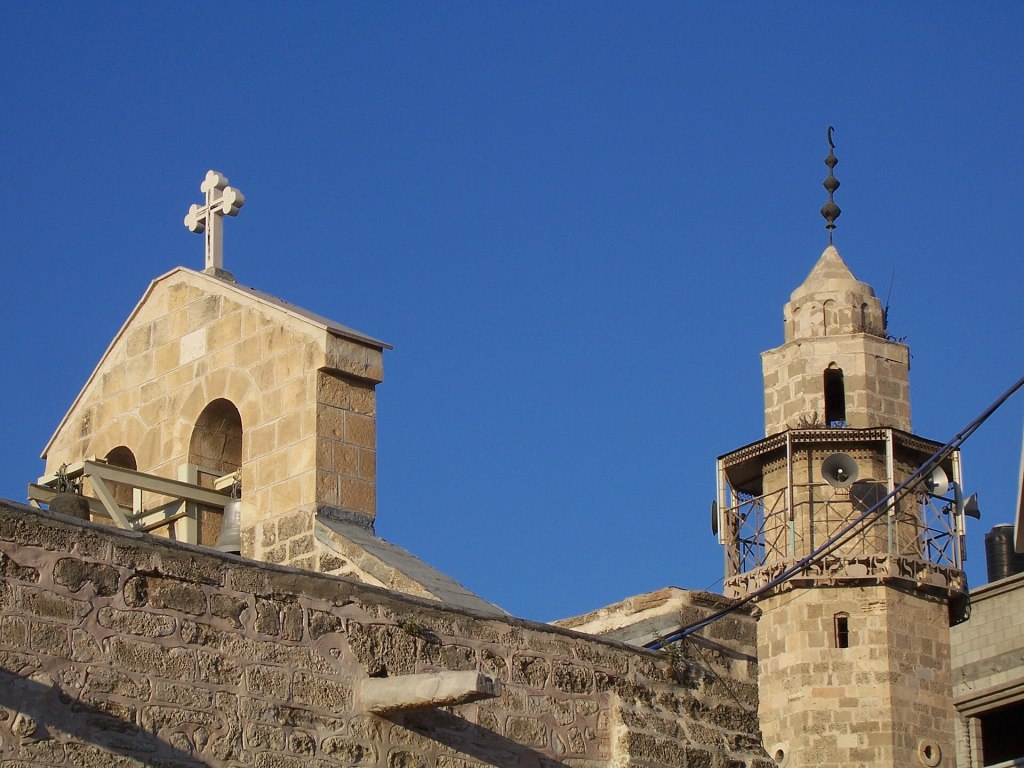
Attribution for Image: “Tolerance” by Rahim Abaid licensed under CC BY 3.0 (https://upload.wikimedia.org/wikipedia/commons/d/d3/Tolerance_-_panoramio.jpg?utm_source=commons.wikimedia.org&utm_campaign=index&utm_content=original)


Leave a Reply