

• Bryce Crawford is Dead Wrong About the Danger Faced by Gaza’s Christians
    Image of the Church of St. Porphyrius in Gaza.
    Image of the Church of St. Porphyrius in Gaza (See Attribution)

    In recent weeks, a clip from earlier this year has resurfaced in which Christian influencer Bryce Crawford said “If someone right now stood up and walked in the middle of the Gaza Strip and said ‘I’m a Christian,’ before they could even finish that sentence they’d be killed, and you and I are too nervous to share our faith because we’re ‘scared.’”

    Crawford used this statement to build a broader point, arguing that there is no good reason to avoid proselytizing in the environment in which American Christians live, where no such thing would happen.

    That said, this article isn’t about Crawford’s broader point, it’s about the claim he used to set it up: Is it true that someone would be shot dead in Gaza for proclaiming they are Christian? And if it isn’t true, does it matter that he said that?

    The answers to these questions are “no” and “yes” respectively. It is not true that someone would be shot dead in the Gaza Strip for proclaiming their faith in Christ and it does matter that Bryce Crawford would tell such a lie.

    The True Danger to Christians in Gaza

    While it is absolutely true that Christians in the Gaza Strip face grave danger, the reality of this persecution is not at all like Bryce Crawford insinuated in his statement.

    When Crawford claimed that someone proclaiming their faith in Christ in the Gaza Strip would be shot dead before they could finish the statement, he was clearly insinuating that the people of the Gaza Strip are violently hostile towards Christians.

    Yet, if we are to compare Bryce Crawford’s insinuation about what it’s like to be a Christian in Gaza with the reality the Christians who live in Gaza actually face, we find a very different story.

    In reality, the greatest perpetrator of violence against Christians in the Gaza Strip is the State of Israel and its armed forces. If you don’t believe me, all you have to do is look at the history of Gaza’s three churches: the Church of St. Porphyrius (Greek Orthodox), The Holy Family Church (Catholic), and the Gaza Baptist Church.

    While there are no confirmed reports of Muslim attacks on any of these churches, all three of these churches have been attacked by the IDF in several incidents including both before and after October 7, 2023.

    The Church of St. Porphyrius is the oldest church in the Gaza Strip, with its current building dating back to the mid-12th century. The church was attacked for the first time in its nine-hundred-year history (which included eight centuries of Muslim rule) in 2014, when it was shelled by an IDF tank. In October 2023, the IDF bombed the church, killing 18 civilians, and attacked it once again in July 2024 – injuring several people.

    The Holy Family Church is the newest church in Gaza, which was built in 1965. The first time the church was ever attacked was in a 2014 IDF bombing which damaged the church’s school and the pastor’s office. Seven years later in 2021, another IDF bombing damaged the church’s convent school.

    In December 2023, two members of the church’s congregation (a mother and daughter) were murdered by an IDF sniper as they were leaving the church. The Holy Family Church was also notoriously bombed in July 2025 by an IDF jet without any prior warning, killing three elderly people sheltering there and injuring the parish’s priest.

    Lastly, the Gaza Baptist Church (which was founded in 1954) had its windows blown out in an Israeli airstrike in 2008, an incident which led seven of its leaders to flee to Jordan and the West Bank. The Israeli government has only allowed one of these leaders – Rev. Hanna Massad – to return to his family since then, separating the rest of the church’s leaders from their families by force.

    Gaza Baptist Church also sustained minor damage in October 2023, followed by much more serious damage the day after Christmas that same year when an IDF tank shelled the building.

    Just last month, Rev. Massad reported that two members of his congregation – a grandmother and daughter – were killed by an Israeli airstrike on their home. Rev. Massad also stated that about half of Gaza’s Christian community has been killed in the past three years as a result of the genocidal violence committed by the State of Israel.

    Similar claims have been echoed by Palestinian Lutheran Priest Rev. Dr. Munther Isaac, who has warned the world that Israeli apartheid, ethnic cleansing and genocide threaten the extinction of the world’s oldest Christian community.

    Taken together, it is no mystery that Christians in Gaza are under grave threat of annihilation, and it is no secret that the State of Israel is to blame; and that’s why it matters when people like Bryce Crawford insinuate something different.

    Why It Matters

    While it would be naive to suggest that there is no conflict between Christians and Muslims in Palestine, the fact of the matter is that Muslims are not the reason why the existence of the Palestinian Christian community is threatened by extinction. Furthermore, it is the State of Israel – not Muslim Palestinians – that are responsible for the vast majority of violence committed against Palestinian Christians.

    That’s why it matters when Bryce Crawford – or anyone else – insinuates that Muslims are to blame for this situation. The notion that the people of Gaza are hostile to Christians to the point that they would gun down anyone who publicly proclaims faith in Christ is an ugly lie, and telling that lie only serves to justify (even if subtly) the genocide that is being wrought on Gaza.

    Repeating this lie obscures the truth about who the main perpetrators of violence against Palestinian Christians are, and it assists these perpetrators in gaining approval for their violence by dehumanizing the people of Gaza and suggesting that they are intolerant barbarians who aren’t worthy of life.

    It’s no different than claims that the people in Gaza indiscriminately kill gay people (which Bryce Crawford has also repeated) or the time that the late Charlie Kirk joked that Gazans couldn’t throw gay people off of tall buildings anymore because there weren’t any tall buildings left.

    These notions (that people in Gaza attack churches and Christians and that the people in Gaza throw gay people off of buildings) have two things in common: there is not a single confirmed report of either of these things happening, and both of these things are cited to implicitly or explicitly excuse the mass murder of the people of Gaza.

    When it comes down to it, Bryce Crawford could have cited any real example of Christian persecution to make his point: he could have pointed out that Israel destroys churches in Gaza, the West Bank, the Golan Heights and Lebanon; or that Saudi Arabia does not allow any churches to exist within its borders. Yet instead, he repeated a lie that portrayed the people of Gaza as enemies of Christians, while simultaneously erasing the existence of the Christians who live in Gaza.

    In the spirit of being charitable, I do not intend to suggest that Bryce Crawford is intentionally trying to dehumanize the people of Gaza. That said, even if he is unaware of the fact that he is lying, it is a poor reflection on his qualification to be a teacher in the Christian community.

    One does not need to be intentionally malicious to incur judgment or responsibility for what they say. James 3:1 warns us that not all of us should be teachers, because those who teach will be judged more strictly. Proverbs 12:18 warns us that rash words are like sword thrusts. The Bible is clear that lying, even if done unintentionally, is harmful.

    Thus, to conclude, I want to say this: Bryce Crawford is dead wrong about the danger faced by Gaza’s Christians.

    May Christ have mercy on us all.

    Maran atha.

    Attribution for Image: “Tolerance” by Rahim Abaid licensed under CC BY 3.0 (https://upload.wikimedia.org/wikipedia/commons/d/d3/Tolerance_-_panoramio.jpg?utm_source=commons.wikimedia.org&utm_campaign=index&utm_content=original)
  • After a few years of personal research, social media discourse, and seminarian study I have finally decided to launch Nuni de Menei, a Christian website featuring apologetics, reflections, and all things biblical from an Oriental Orthodox perspective.

    The name of this website comes from the first three words of the original Greek text of I Corinthians 13:13 which are: “νυνὶ δὲ μένει.” Their meaning can roughly be translated to “Now [these] remain.” in reference to faith, hope, and love; the greatest of which is love.

    This site’s mission is grounded in these three things: from championing the truth of our faith in the face of false teachings and misinformation, to defending a moral worldview grounded in the royal law: “You shall love your neighbor as yourself.” (Lv. 19:18, Mt. 22:37-40, Mk. 12:31, Lk. 10:27, Jn. 13:34, Rom. 13:9-10, Gal. 5:14, Jas. 2:8, 1 Jn. 4:21)

    My vision for this site is to build it up to be a resource for thoughtful Christian content for the curious believer and non-believer alike.

    I intend to publish a variety of content on this site in several concurrent yet distinct series. The first of which will be titled “The New Frontier of Christian Apologetics,” which is focused on defending the integrity of the Christian belief system from those who represent it poorly on social media.

    Other series will be focused on a variety of topics from the history of the Church and the Bible, to apologetics responding to the claims of people from other belief systems.

    Regardless of how you found this website, I am happy that you are here.

    Maran atha.

    Sem. G. R. George

  • No, they aren’t; but some have claimed otherwise.

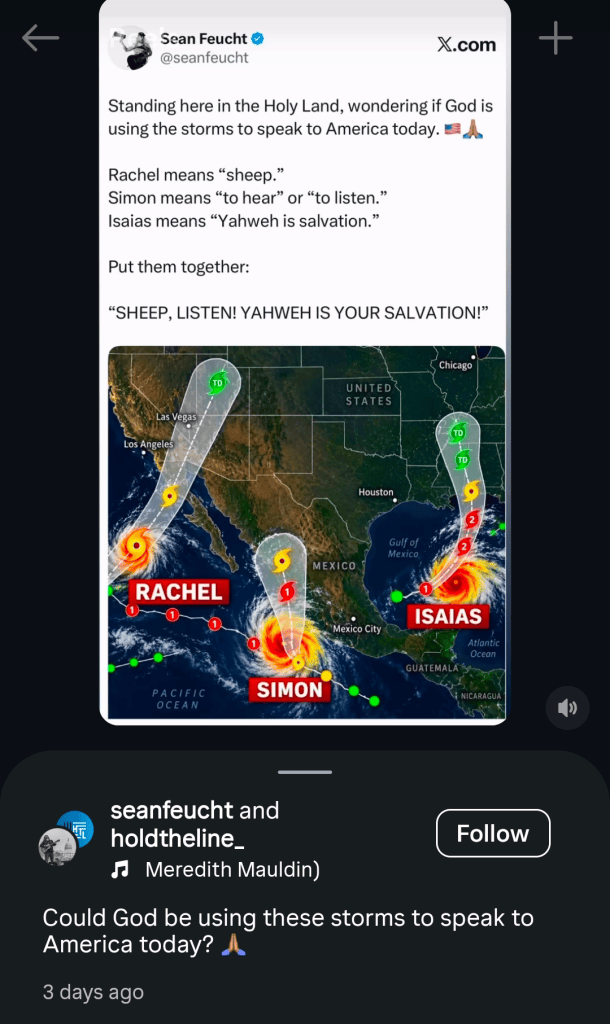
    Earlier this week, three tropical cyclones named Rachel, Simon and Isaias hit North America. All three of these storms’ names are Hebrew in origin, prompting Christian influencer Bradley Mayes to make a video (posted on 9 October, 2026) claiming that these three names translate to “Sheep, listen, Jesus is salvation.”

    In any situation in which I am getting into apologetics, I think it is important to hear out the person who I am responding to, so I encourage you to watch the original video on Instagram (or our archived copy on Youtube) before reading this article.

    If you watch the video, you will find that it begins with a hook: “Okay, you cannot tell me God does not exist after watching this.”

    This frames it as an attempt at Christian apologetics, but are the claims true? Do they make an effective argument for Christianity? Unfortunately, the answer to both of these questions is “No.”

    The Problem with this Video

    The primary problem with this video is that the main point made in it is completely incorrect. “Rachel, Simon, Isaias” is not Hebrew for “Sheep, listen, Jesus is salvation,” nor do the original Hebrew names mean that.

    To begin with, “Rachel” means “a ewe,” a singular female sheep. It does not, and cannot refer to male sheep, nor more than one sheep.

    Secondly, the name “Simon” originates in Genesis 29:33, where Leah gives her son the name Shimon (often translated “Simeon” here), with her reason being “Because the Lord has heard that I am hated.”

    Given the context of this verse, the Hebrew meaning of the name Simon (and Simeon) is typically interpreted to mean “He has heard” or “Hearing.”

    If you watched the video, you may have noticed that the creator originally stated this meaning correctly, saying it meant “he has heard.” However, in the final translation, he tweaked it, translating it to the command “listen.”

    While Simon (“Shimon” in Hebrew) does in fact derive from the Hebrew word “shama” meaning “listen” or “hear,” Simon is still a noun in Hebrew and it does not and cannot be used to signify any conjugated form of the verb “shama.”

    Finally, the creator of the video also made a small mistake in saying that Isaias (“Ysha’yah” in Hebrew) means “Jesus is salvation.” The name actually means “Jah is salvation.”

    Jah is a short form of Jehovah, or Yahweh – which is the name of the Triune God, not the person of God the Son. (Hence the fact that there are still many Jews today with this name).

    With all that said, if we take this together, we find that “Rachel, Simon, Isaias” (or “Rachel, Shimon, Ysha’yah”) does not translate to “Sheep, listen, Jesus is salvation.”

    Rather, it means “A ewe, he has heard, Jah is salvation.” It does not form a coherent sentence at all, and only one of the names (Isaias) is load bearing in lending any semblance of spiritual significance..

    Sure, one could say that Rachel does have something to do with sheep, Simon has something to do with listening, and the meaning of the name Isaias is a statement of spiritual truth; and it may even be tempting to think that this makes it “close enough,” but it doesn’t.

    Why? Because you can’t set what you want something to say as the starting point of finding out what it means, that is called eisegesis (reading into something’s meaning).

    The only two way that you can come to the conclusion that “Rachel, Simon, Isaias” means “Sheep, listen, Jesus is salvation” is by overestimating your knowledge of Biblical Hebrew and/or deciding that it means that beforehand.

    It’s analogous to the pseudo-etymology that leads one to conclude that saying you are getting a “master’s” degree in a certain “field” is a callback to slavery. (It isn’t.)

    Lastly, it’s also worth noting that looking to weather patterns as a way to answer questions about spiritual matters or uncover knowledge is an occult practice called “aeromancy.” If weather patterns are enough to convert someone to Christianity, they will be enough to steer them away from it too.

    The Reactions to this Video

    The best way to judge a teaching is by its fruits, and the most apparent way to see the impact of a video on the discourse is to see how people reacted.

    Sean Feucht, a notable figure in the New Apostolic Reformation movement who is associated with the controversial charismatic Bethel Church tweeted out a similar claim the day after Mayes posted his video. Feucht also posted it to his Instagram with the caption “Could God be using these storms to speak to America today?”

    On both Mayes’ and Feucht’s posts alike, the comment sections were very similar.

    The most common criticism of these claims was that God didn’t name these storms, so it was ridiculous to ascribe spiritual significance to it. Just as many people countered this critique, saying that it was no coincidence that these storms – named years ago – hit North America simultaneously.

    While I find the counterargument here to be more compelling than the dismissal of the whole thing because “God didn’t name the storms,” it is a moot point regardless. There is no significance to be found in the co-ocurrence of these storms in the first place, because their names don’t have the special hidden meaning that Mayes and Feucht suggested.

    There were also countless comments of people saying that they were sure that this was a sign, and even people who claimed that they fact-checked it and found it to be an accurate translation (which we have debunked here).

    Comments from skeptics were disdainful of the message, with one commenter responding to the opening claim of the video (“Okay, you cannot tell me God does not exist after watching this.”) by simply stating “I watched it, God does not exist.” Another person commented “What an idiotic post.”

    While it is true that hard-heartedness is a reality in some people’s disposition, a sharp divide between apparent believers and non-believers in a comment section like this is indicative of the fact that this video is an example of bad apologetics.

    There was not a single comment I saw in the comment section that indicated anyone’s mind was changed. Those who did not believe saw the video and thought less of Christianity, and many who already did believe heard exactly what they wanted to hear: confirmation that they are right.

    In short, regardless of the intent of the creator of this post, it projected an image of the Christian faith as a superstitious, backward and pseudo-intellectual belief system and it had no apparent positive impact on the minds of skeptics.

    Final Thoughts

    After taking a critical look at this video from a Christian perspective, and what spiritual lessons we can take away from it; two pericopes from Paul’s Epistles came to mind.

    The first one that came to mind was “Paul’s Charge to Timothy” (2 Timothy 3:10-4:8), which had me thinking of how we need to be careful not to allow ourselves to wander into false teachings just because it may appeal to our emotions and sensibilities. These types of videos can set a trap for people already convinced of the existence of God, because it can feel like a satisfying grain of self-assurance in your own belief system; yet in reality, this was something totally made up.

    If we let our faith be built upon false tidbits like the central claim of the video in question here, it will be weak just like the house built on sand (“Hearers and Doers,” Mt. 7:24-29).

    In Paul’s Charge to Timothy, Paul reminds Timothy of the usefulness of Scriptures for teaching, reproof, and training in righteousness; and goes on to warn that there will come a day when people will opt for teachers who tickle their ears and lead them to wander into myths.

    The content of the video addressed in this article not only opens an opportunity for people to wander into a myth (that the tropical storms named Rachel, Simon and Isaias conceal a message from God about salvation); but it also suggests something untrue about the way in which God reveals himself to us.

    This brings us to the second spiritual lesson: that when God wishes for something to be made known, he makes it known. God does not hide himself behind occult practices such as aeromancy and subtle clues from warped etymology of names we gave to tropical cyclones. On the contrary, the Orthodox faith teaches that God has already made himself known through a continuous act of divine revelation.

    This is clearly laid out in the pericope “The Guilt of Humankind” (Romans 1:18-32), in which Paul writes “For what can be known about God is plain to them, because God has made it plain to them. Ever since the creation of the world God’s eternal power and divine nature, invisible though they are, have been seen and understood through the things God has made.” (vv. 19-20)

    God is real, and this reality is not subtle; and thus, when one prefaces a video about tropical cyclone names with the words “Okay, you cannot tell me God does not exist after watching this.” they are suggesting something else entirely.

    With all that said, think twice about the “apologetics” you come across when you are scrolling.

    Maran atha.