
No, they aren’t; but some have claimed otherwise.
Earlier this week, three tropical cyclones named Rachel, Simon and Isaias hit North America. All three of these storms’ names are Hebrew in origin, prompting Christian influencer Bradley Mayes to make a video (posted on 9 October, 2026) claiming that these three names translate to “Sheep, listen, Jesus is salvation.”
In any situation in which I am getting into apologetics, I think it is important to hear out the person who I am responding to, so I encourage you to watch the original video on Instagram (or our archived copy on Youtube) before reading this article.
If you watch the video, you will find that it begins with a hook: “Okay, you cannot tell me God does not exist after watching this.”
This frames it as an attempt at Christian apologetics, but are the claims true? Do they make an effective argument for Christianity? Unfortunately, the answer to both of these questions is “No.”
The Problem with this Video
The primary problem with this video is that the main point made in it is completely incorrect. “Rachel, Simon, Isaias” is not Hebrew for “Sheep, listen, Jesus is salvation,” nor do the original Hebrew names mean that.
To begin with, “Rachel” means “a ewe,” a singular female sheep. It does not, and cannot refer to male sheep, nor more than one sheep.
Secondly, the name “Simon” originates in Genesis 29:33, where Leah gives her son the name Shimon (often translated “Simeon” here), with her reason being “Because the Lord has heard that I am hated.”
Given the context of this verse, the Hebrew meaning of the name Simon (and Simeon) is typically interpreted to mean “He has heard” or “Hearing.”
If you watched the video, you may have noticed that the creator originally stated this meaning correctly, saying it meant “he has heard.” However, in the final translation, he tweaked it, translating it to the command “listen.”
While Simon (“Shimon” in Hebrew) does in fact derive from the Hebrew word “shama” meaning “listen” or “hear,” Simon is still a noun in Hebrew and it does not and cannot be used to signify any conjugated form of the verb “shama.”
Finally, the creator of the video also made a small mistake in saying that Isaias (“Ysha’yah” in Hebrew) means “Jesus is salvation.” The name actually means “Jah is salvation.”
Jah is a short form of Jehovah, or Yahweh – which is the name of the Triune God, not the person of God the Son. (Hence the fact that there are still many Jews today with this name).
With all that said, if we take this together, we find that “Rachel, Simon, Isaias” (or “Rachel, Shimon, Ysha’yah”) does not translate to “Sheep, listen, Jesus is salvation.”
Rather, it means “A ewe, he has heard, Jah is salvation.” It does not form a coherent sentence at all, and only one of the names (Isaias) is load bearing in lending any semblance of spiritual significance..
Sure, one could say that Rachel does have something to do with sheep, Simon has something to do with listening, and the meaning of the name Isaias is a statement of spiritual truth; and it may even be tempting to think that this makes it “close enough,” but it doesn’t.
Why? Because you can’t set what you want something to say as the starting point of finding out what it means, that is called eisegesis (reading into something’s meaning).
The only two way that you can come to the conclusion that “Rachel, Simon, Isaias” means “Sheep, listen, Jesus is salvation” is by overestimating your knowledge of Biblical Hebrew and/or deciding that it means that beforehand.
It’s analogous to the pseudo-etymology that leads one to conclude that saying you are getting a “master’s” degree in a certain “field” is a callback to slavery. (It isn’t.)
Lastly, it’s also worth noting that looking to weather patterns as a way to answer questions about spiritual matters or uncover knowledge is an occult practice called “aeromancy.” If weather patterns are enough to convert someone to Christianity, they will be enough to steer them away from it too.
The Reactions to this Video
The best way to judge a teaching is by its fruits, and the most apparent way to see the impact of a video on the discourse is to see how people reacted.
Sean Feucht, a notable figure in the New Apostolic Reformation movement who is associated with the controversial charismatic Bethel Church tweeted out a similar claim the day after Mayes posted his video. Feucht also posted it to his Instagram with the caption “Could God be using these storms to speak to America today?”
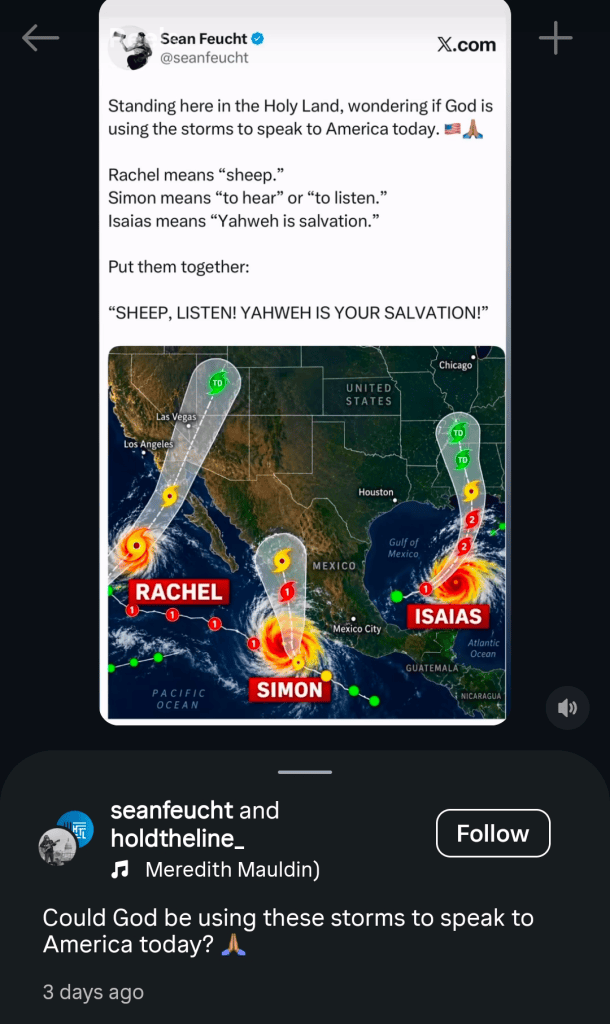
On both Mayes’ and Feucht’s posts alike, the comment sections were very similar.
The most common criticism of these claims was that God didn’t name these storms, so it was ridiculous to ascribe spiritual significance to it. Just as many people countered this critique, saying that it was no coincidence that these storms – named years ago – hit North America simultaneously.
While I find the counterargument here to be more compelling than the dismissal of the whole thing because “God didn’t name the storms,” it is a moot point regardless. There is no significance to be found in the co-ocurrence of these storms in the first place, because their names don’t have the special hidden meaning that Mayes and Feucht suggested.
There were also countless comments of people saying that they were sure that this was a sign, and even people who claimed that they fact-checked it and found it to be an accurate translation (which we have debunked here).
Comments from skeptics were disdainful of the message, with one commenter responding to the opening claim of the video (“Okay, you cannot tell me God does not exist after watching this.”) by simply stating “I watched it, God does not exist.” Another person commented “What an idiotic post.”
While it is true that hard-heartedness is a reality in some people’s disposition, a sharp divide between apparent believers and non-believers in a comment section like this is indicative of the fact that this video is an example of bad apologetics.
There was not a single comment I saw in the comment section that indicated anyone’s mind was changed. Those who did not believe saw the video and thought less of Christianity, and many who already did believe heard exactly what they wanted to hear: confirmation that they are right.
In short, regardless of the intent of the creator of this post, it projected an image of the Christian faith as a superstitious, backward and pseudo-intellectual belief system and it had no apparent positive impact on the minds of skeptics.
Final Thoughts
After taking a critical look at this video from a Christian perspective, and what spiritual lessons we can take away from it; two pericopes from Paul’s Epistles came to mind.
The first one that came to mind was “Paul’s Charge to Timothy” (2 Timothy 3:10-4:8), which had me thinking of how we need to be careful not to allow ourselves to wander into false teachings just because it may appeal to our emotions and sensibilities. These types of videos can set a trap for people already convinced of the existence of God, because it can feel like a satisfying grain of self-assurance in your own belief system; yet in reality, this was something totally made up.
If we let our faith be built upon false tidbits like the central claim of the video in question here, it will be weak just like the house built on sand (“Hearers and Doers,” Mt. 7:24-29).
In Paul’s Charge to Timothy, Paul reminds Timothy of the usefulness of Scriptures for teaching, reproof, and training in righteousness; and goes on to warn that there will come a day when people will opt for teachers who tickle their ears and lead them to wander into myths.
The content of the video addressed in this article not only opens an opportunity for people to wander into a myth (that the tropical storms named Rachel, Simon and Isaias conceal a message from God about salvation); but it also suggests something untrue about the way in which God reveals himself to us.
This brings us to the second spiritual lesson: that when God wishes for something to be made known, he makes it known. God does not hide himself behind occult practices such as aeromancy and subtle clues from warped etymology of names we gave to tropical cyclones. On the contrary, the Orthodox faith teaches that God has already made himself known through a continuous act of divine revelation.
This is clearly laid out in the pericope “The Guilt of Humankind” (Romans 1:18-32), in which Paul writes “For what can be known about God is plain to them, because God has made it plain to them. Ever since the creation of the world God’s eternal power and divine nature, invisible though they are, have been seen and understood through the things God has made.” (vv. 19-20)
God is real, and this reality is not subtle; and thus, when one prefaces a video about tropical cyclone names with the words “Okay, you cannot tell me God does not exist after watching this.” they are suggesting something else entirely.
With all that said, think twice about the “apologetics” you come across when you are scrolling.
Maran atha.


Leave a Reply